

According to the GUS publication ‘The Information Society in Poland in 2026’, 72.9 per cent of people aged 16–74 had ordered or purchased something online in the last 12 months. At the same time, 71 per cent of those surveyed by Gemius do not want to leave independent purchasing decisions to AI. For a shop, therefore, what matters most today is the moment of choice: what the AI recommends before the customer clicks ‘buy’ themselves.
In this guide, we show you exactly what to measure, how to choose your questions and what Google Analytics won’t show you.
Why one result isn’t enough for a shop
A service company usually wants to know one thing: whether AI recommends it. An online shop has a harder time of it, because three different sites can come out on top in a single answer. AI might praise your brand, suggest a product from another manufacturer and send the buyer to Allegro.
The shop from the test described at the beginning performed well when someone asked where to buy a particular type of product or which shop to choose. However, when a customer asked about a specific item – for example, a product within a certain price range – ChatGPT was less likely to suggest it. The questions did not include the shop’s name; instead, we counted its name in the text, product listings and cited sources.
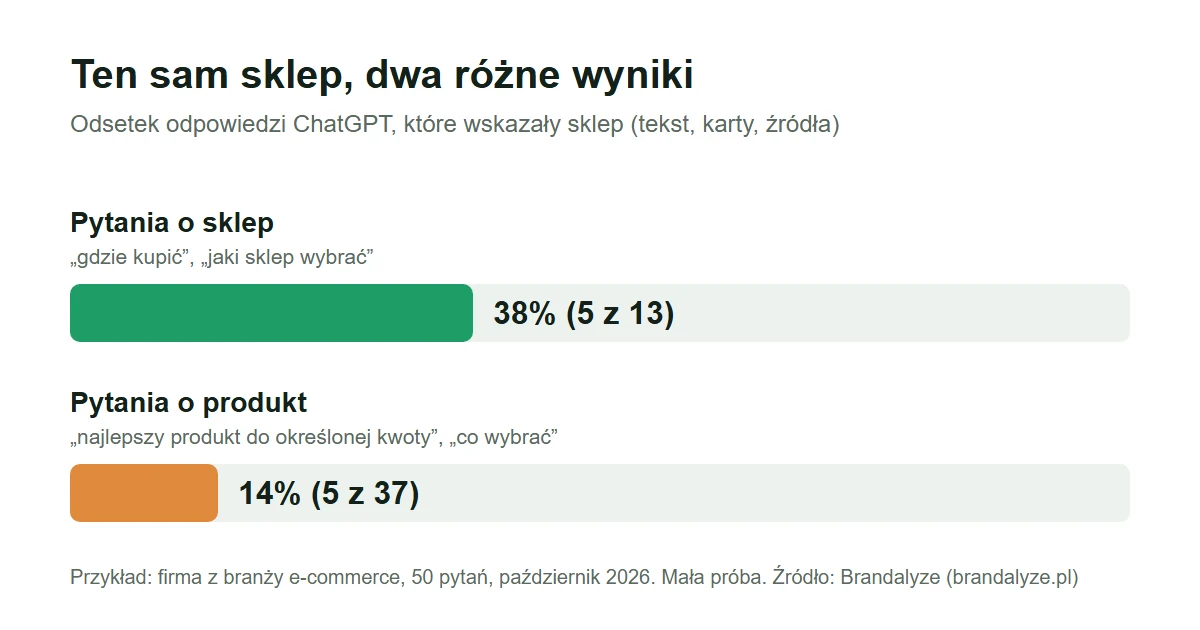
In total, this amounts to 10 out of 50 answers, or 20 per cent, and this figure would not tell us much on its own. It is still just one metric, calculated separately for two groups of questions. This breakdown alone shows where to start looking, but does not explain the cause. Therefore, in ongoing measurement, it is worth going further and separating three things.
Three metrics that need to be separated
| Measurement | What question does it answer? | What to count |
|---|---|---|
| Brand | Does AI recognise and mention my shop? | Percentage of answers in which the shop’s name appears |
| Product | Does AI recommend what I’m selling? | Percentage of answers featuring your product range, in the text and on product cards within AI answers |
| Place of purchase | Where does the buyer end up? | Your shop’s share of all purchase location mentions |
Here, the term ‘product card’ refers to a tile in an AI answer, featuring a photo and price, rather than a product page on your shop. The third metric is easy to overlook. You might be selling a product that the AI praises, yet still fail to attract a customer because someone else appears as the seller. That is why AI visibility in e-commerce goes beyond just the brand name.
What GUS data tells us about customers and shops
Data from the Central Statistical Office (GUS) provides the background to these measurements: the proportion of online shoppers continues to rise, and significantly more people are now using AI tools than a year ago. However, only a minority of businesses engage in e-commerce, and some of them use e-commerce platforms.
| GUS indicator | 2025 | 2026 |
|---|---|---|
| Online shoppers (12 months) | 69.7% | 72.9% |
| People using AI tools (3 months) | 22.7% | 39.8% |
| Companies using AI | 8.7% | 17.8% |
The gap between urban and rural areas is also narrowing. In 2026, 75.8 per cent of urban residents and 68.6 per cent of rural residents shopped online, with the difference falling from 10.1 to 7.2 percentage points.
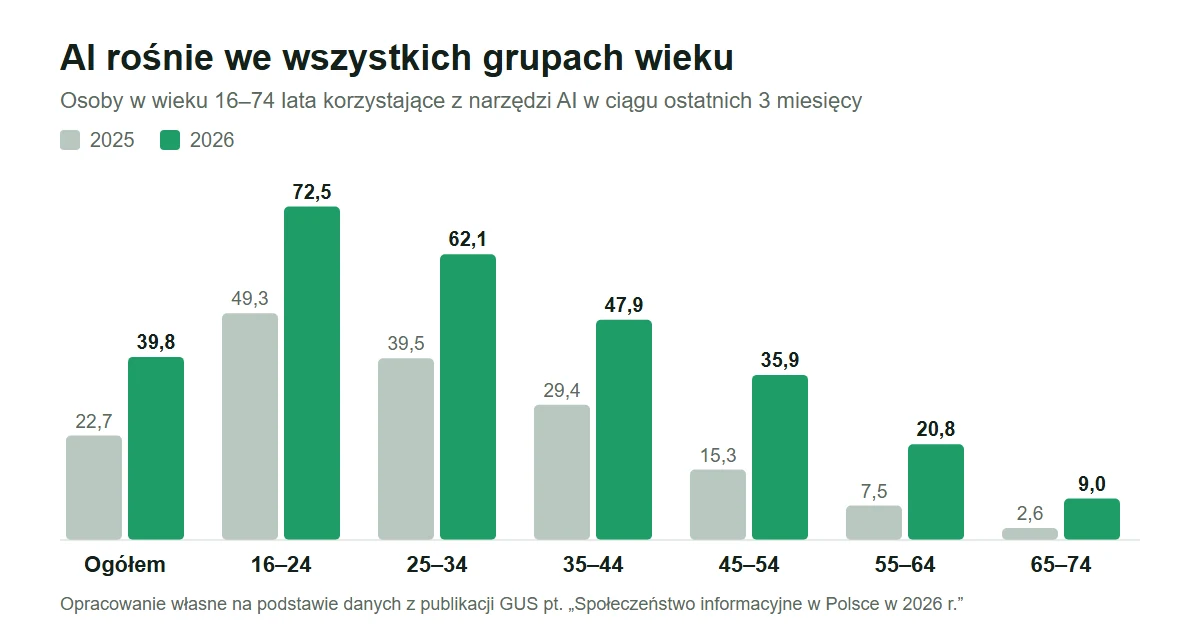
72.5 per cent of people aged 16–24 use AI tools, but the figure rises to 35.9 per cent in the 45–54 age group, compared with 15.3 per cent a year earlier. A shop should therefore not assume that AI is only relevant to its youngest customers.
On the business side, in 2025, 18.2 per cent of companies were conducting e-commerce: 12.4 per cent via their own websites or apps, and 10.4 per cent via online marketplaces. These groups overlap to some extent, as a company may sell through both channels. However, an in-house shop and an online marketplace are two different channels, which is why it is worth using AI to track the point of purchase. Companies also most frequently use AI in marketing and sales (11.1 per cent of businesses).
However, GUS does not measure how many people ask AI about shopping, nor which shops AI recommends. This gap must be filled by our own measurements.
How to determine where AI directs the buyer
You will determine the point of purchase based on three indicators. Record each one separately, as they carry different weights:
- The seller on the product page in AI answers. This is the strongest signal, as the buyer sees it next to the price.
- Shop name in the text. For example, ‘you can buy this at…’. This is an instruction, even if there is no link alongside it.
- Domains cited in the answer. These show which websites the AI uses. However, the guide or comparison site cited is not a retailer.
Assign each mention to one of six groups: your shop, a marketplace (e.g. Allegro), a competitor’s shop, a price comparison site (e.g. Ceneo), another website (guide, brand website) or ‘unknown’. One mention equals one instance in a single answer. If signals regarding the same location differ, take the strongest one. If the listing does not specify a seller, check the link’s domain. Listings without a link or with a link to a search engine go into the ‘unknown’ group. Do not guess who is behind them.
Example calculation (fictitious figures): in 20 AI answers, 40 places to buy were identified. Your shop had 6 mentions, the marketplace 14, competitors 10, price comparison sites 3, other websites 1, and 6 were unknown. Your share is 6 out of 40, or 15 per cent. If you exclude the unknown ones, it comes to 6 out of 34, or approximately 18 per cent. Choose one method of calculation and stick to it.
If you also sell on Allegro, list your marketplace offers separately. The sales are then yours, but the channel is no longer yours.
Which questions to choose for measurement
Questions are divided into two groups, and the results for each must be reported separately:
| Group | Examples of questions | What it checks |
|---|---|---|
| About the shop | ‘Where can I buy…’, ‘Which shop selling… is trustworthy?’, ‘Where is the fastest delivery for…?’ | Brand recognition and trust in the shop |
| About the product | ‘The best… up to 500 PLN’, ‘… or …, which to choose?’, ‘What to buy as a present for…?’ | The presence of specific products |
Please bear the following four points in mind:
- Do not include the shop name in the question. Brand-related questions artificially inflate the score, so count them separately.
- Questions by category, not by SKU. With thousands of products, you can’t measure every single one. Focus on the categories that generate the most sales and a few products that matter most to you.
- Client’s language. Add the budget, use case and opportunity if they match your offering.
- A fixed set. Without it, you won’t be able to distinguish the effect of changes from a different choice of words. Read more in the article How many questions to measure and how often.
ChatGPT and Google need to be read differently
In shopping-related queries, ChatGPT often displays product cards alongside plain text, and a seller may appear on these cards. The text alone is therefore not sufficient to assess the point of purchase. OpenAI states that product results are not advertisements and that ChatGPT selects them independently. It takes into account, amongst other things, structured data from its own and external providers, as well as the user’s context.
According to the same page, the list of sellers for ChatGPT products is organised according to factors such as availability, price, quality and whether the seller is a manufacturer or a main distributor. Shops on Shopify have their product data linked to ChatGPT via Shopify Catalog, and sellers can also apply for a direct feed. OpenAI also warns that changes to prices and delivery costs may be delayed, so it is worth checking what the AI displays for your products.
Google displays answers in several places: in AI Overviews, in AI mode and in standard shopping results. The AI Overview does not appear for every query, so first check which ones it does appear for. Google states that these features have no additional requirements or special structured data, but recommends keeping your information up to date in Merchant Centre.
In a separate test of 50 shopping-related questions across 10 sectors (ChatGPT, October 2026), the seller was only listed on cards containing data from Google Shopping, and in most cases this was Allegro. The remaining cards did not list a seller, and their links led to price comparison sites, shops, guides and brand websites, amongst others. This is an observation from a single test. It does not prove that simply adding products to Merchant Center will automatically cause the shop to appear as the seller. The proportion of cards containing data from Google Shopping also varied across sectors.
What Google Analytics won’t show you
GA4 only measures recognisable visits. It does not detect answers where a customer has read about you but not clicked, nor those where a competitor has been recommended.
Simply counting visits can also be unreliable. In October 2026, some links from ChatGPT lost their UTM tags, and visits were categorised as ‘Direct’. After a few days, the tags returned, but a shop looking solely at AI Traffic might have concluded that customers had suddenly disappeared.
A similar issue can be seen in Universal Cart, Google’s shopping basket for products from multiple shops. It currently operates in the US, and once purchases have been forwarded to the shop, Google no longer tracks what happens next.
So treat AI Traffic in GA4 as a lower limit. It is also impossible to reliably attribute orders to a single AI answer, as it is not clear what the customer read before making a purchase. Assess AI-driven sales collectively and in conjunction with visibility. We describe the general rules for calculating visibility on the How we calculate page.
What to check if the result is poor
The following causes are hypotheses to be tested, not a definitive diagnosis:
| What do you see? | Possible cause | Where to start |
|---|---|---|
| Strong brand, weak products | AI may not have accurate data on the offering | Specific titles and descriptions: use, specifications, target audience |
| Recommended product; sold by a different retailer | Another source may have more comprehensive information on price or availability | Merchant Centre, structured data, price and stock consistency |
| Weak brand, competitors cited | You may not appear in the sources that the AI reads | Gaps in sources: rankings, portals, comparison sites |
| Many ‘unknown’ results | Product pages may not have a seller or a link to a shop | Check which products are listed on these tabs and whether yours are among them |
For product data, Google recommends linking the structured data on your website to your feed in Merchant Centre. Also, ensure that the price, delivery and returns details in the feed match those on your shop.
A simple monthly report for the shop
- Brand presence in questions about the shop and trends compared with previous months.
- Product presence in product-related questions, broken down by key categories.
- Breakdown of purchase locations into six groups, including unknown answers.
- The three categories where you’ve lost the most, and the three where you’ve gained the most.
- New sources cited by AI.
- AI source inputs in GA4, highlighting changes to the measurement method.
- What has changed in the data and content this month.
What this metric won’t tell you
AI answers are variable. A single measurement is like a snapshot: repeating it on another day or with different questions will yield different figures. This also applies to the example in this article, which is based on a small sample. Answers may also depend on the user, as ChatGPT takes their context into account, such as their memory and its own instructions.
So assess the trend over several weeks, rather than a single percentage. For each figure, note how many answers it is based on and which search engines they come from. If there is little data, state this clearly. When measuring manually, use an account without a history and follow your own instructions.
Frequently Asked Questions
Does a shop need to have a Merchant Centre to be visible in AI?
Google does not impose such a requirement on its AI features, and the AI may also recommend a shop based on its website and other sources. However, Google recommends keeping data in Merchant Centre up to date. For a shop, this is usually a simple way to provide price and availability information in a structured format.
Should we measure individual products or entire categories?
Start with the categories and a few key products. Measuring every SKU only makes sense once you know which products the AI mentions at all.
What should I do if AI recommends Allegro instead of my shop?
First, check whether this is your product. If so, you’ve made a sale, but you’ll pay commission and won’t have full contact with the customer. If not, compare the product details, price and availability on your own site and on the marketplace, then check the sources used by the AI.
Is AI already making purchases on behalf of customers in Poland?
We have not found any data to support this. Universal Cart currently operates in the US, and the majority of those surveyed by Gemius are unwilling to let AI make purchasing decisions independently. For now, therefore, it is most beneficial to measure who and what AI recommends prior to a purchase.
Where to start
Select the two most important categories, list the questions about the shop and the product, and record the results in six groups based on the place of purchase. You can do this manually or set up these questions in Brandalyze and check them daily. You can find out more about e-commerce measurement on the page Online shop visibility in AI.
Start measuring your company’s visibility in AI
Track responses to customer queries on a daily basis.
Try it for freeFirst payment after 7 days — you can cancel at any time.Or check the site first with a free website audit →